Fluency
How to run a one-minute fluency check
How to run, score and use a one-minute oral reading check, and turn it into repeated reading that older students don't mind.
A one-minute oral reading check is the quickest honest look you'll get at a student's reading. In sixty seconds you hear their accuracy, their pace and how they handle a word they don't know.
Here's how to run one, score it, and turn it into practice that older students don't dread.
Get two copies ready
- A passage the student hasn't read before, at about their level
- A clean copy for the student, with no numbers on it
- Your copy, with a running word count at the end of each line
- A timer and a pencil
The running word count is what makes scoring fast. Without it, you're counting words by hand after every read.
Run the read
Sit beside the student, not across a desk. Keep the directions short and the same every time:
Start the timer on the first word. Follow along on your copy and mark as they read. At sixty seconds, say “thank you” and mark the last word they reached.
Mark errors the same way every time
Most scoring rules agree on the basics. Count as an error:
- A word read wrong, including a wrong ending.
- A word skipped.
- A hesitation of about three seconds. Say the word, and mark it as an error.
Don't count a self-correction as an error: fixing a mistake is exactly what good readers do. Inserted words and repeated words usually aren't counted either. Whatever rules you choose, use the same ones every time, so scores can be compared.
Score it in under a minute
Two numbers tell you most of what you need to know:
Words read − errors = words correct per minute
Example: a student reaches word 112 with 6 errors. 112 − 6 = 106 words correct per minute.
Words correct ÷ words read × 100 = accuracy
Same example: 106 ÷ 112 × 100 ≈ 95% accuracy.
Read what the numbers tell you
Look at accuracy first. If it's well below 95%, the passage is too hard for fluency practice, and the errors are the real lesson. Look at what kind they are: long words, endings, sight words. That points to what to teach next.
Then look at the rate. Compare words correct per minute with your school's benchmarks or published oral reading fluency norms for the grade and time of year. And listen, too: a student can read quickly and still read in a flat, word-by-word way that shows they aren't following the meaning.
Turn it into repeated reading
The same passage makes a strong practice routine. Have the student read it three times over a few days, timing each read, and let them graph the results themselves.
In the example in the picture above, the scores go from 84 to 97 to 109 words correct per minute. For a struggling older reader, watching that bar grow can be the first clear sign that their reading is improving, and that can change how they feel about practicing.
Keep it private, and about growth
Older students are acutely aware of where they stand. Run checks one-on-one, away from an audience, and compare each student only with their own last read, never with classmates. The goal is a student who knows their reading is getting better, because they can see it.
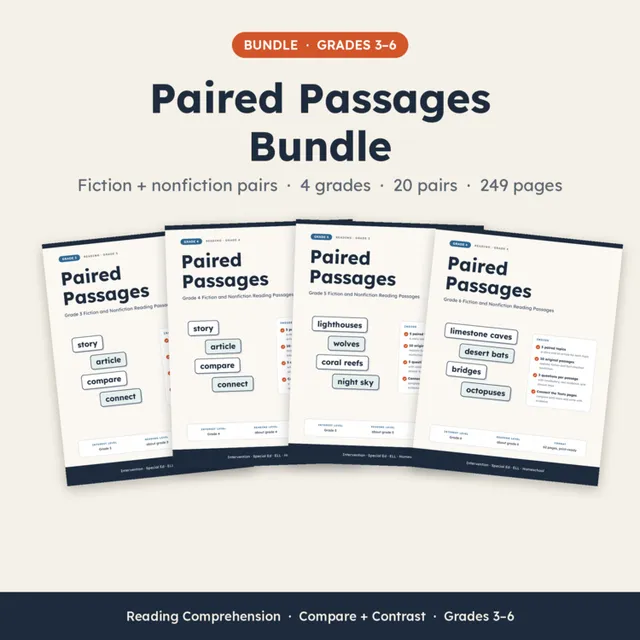
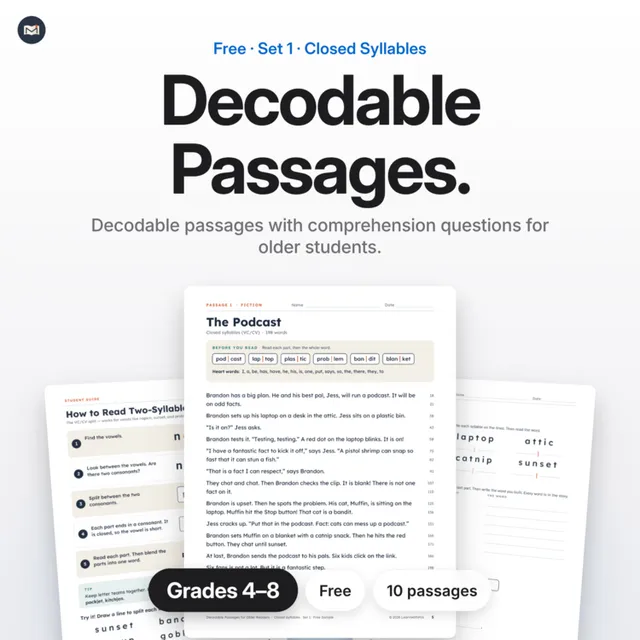
Passages written for older readers make all of this easier. Hi-Lo and paired passages give you grown-up topics at a reading level students can practice with, and the free Closed Syllables set comes with running word counts ready for timed reads.
— Min
Try it with

Free sample · Grades 4–8
Get the free decodable passages
Decodable Passages: Closed Syllables, free for teachers. Join the Learn With Min email list and it comes straight to your inbox, along with new releases.
What's inside
- 10 decodable passages for older readers
- Questions, word work, phrases and dictation for each
- Every word checked for closed syllables (VC/CV), plus a short heart-word list
- Answer keys and running word counts for timed reads
Send me the 51-page sample
Loading the sign-up form…
Occasional emails from Learn With Min. Unsubscribe any time.