Phonics
Teaching closed syllables to older students
Older readers who stumble on long words often need a reliable way in. A closed-syllable routine that works without making a seventh grader feel little.
Plenty of older students can read cat, stop and trust without a second thought, then guess wildly at fantastic. The problem usually isn't the sounds. It's that nobody showed them a reliable way into a long word.
Closed syllables are the place to start. Here's a routine you can teach in a few short lessons, with words and texts that respect a twelve-year-old.
What a closed syllable is
A closed syllable has one vowel, closed in by at least one consonant after it. The vowel is usually short: cat, hand, sit, stretch.
Put two together and you have the two-syllable words older readers meet constantly: nap·kin, mag·net, con·test. Closed syllables are the most common syllable type in English, which is why they're worth teaching first and teaching well.
Why it matters for older readers
From about grade 4, more and more of the new words in a student's reading have more than one syllable. A student who can't break them apart falls back on guessing from the first letter and the picture, and in a science textbook there's no picture to help.
Older students also know they're behind, and they notice anything that feels babyish. So the teaching has to be explicit and quick, and the materials have to look like they belong in a middle-school classroom.
Teach one routine for dividing words
Teach the VC/CV pattern first: when two consonants sit between two vowels, divide between the consonants. Model it out loud with a word on the board, then hand it over:
- Find the vowels and mark each with a small v.
- Mark the consonants between them with a c.
- Divide between the two consonants: nap / kin.
- Read each syllable with a short vowel.
- Blend and check: is that a word you know?
Choose words that respect their age
Skip the picture cards of hens and pigs. Use the real words students meet in class and in life. Start with two syllables:
- napkin
- magnet
- insect
- contest
- sunset
- picnic
- dentist
- plastic
- traffic
- problem
When the routine is automatic, go longer. The same steps still work, one pair of consonants at a time:
- fantastic
- Atlantic
- consistent
- establish
Keep the lessons short and grown-up
Ten to fifteen minutes a day does more than one long lesson a week:
- Model one or two words out loud, thinking as you go.
- Do a few together, with students marking and dividing on whiteboards.
- Let them do a short set on their own, and check right away.
- Finish by reading the words in sentences, not just in a list.
Talk to them as the capable students they are. “Long words follow patterns, and you're learning the patterns” lands better than anything that sounds like a reading group for little kids.
Move from words to real reading
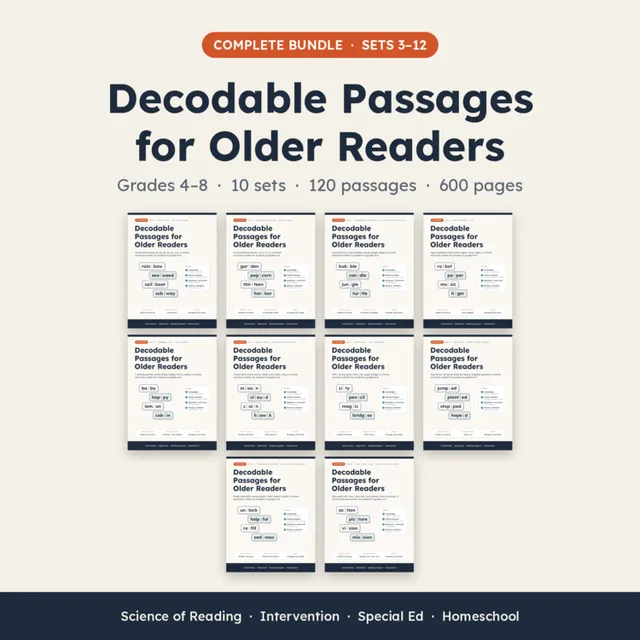
Word lists build the skill; connected text makes it stick. Use decodable passages where nearly every word follows the patterns you've taught, plus a short list of irregular heart words taught ahead of time. For older students, the topics should be ones they'd choose to read about.
Read each passage more than once. The first read is for decoding, the second for smoothness, and a timed third read shows students how much they've grown in a few days.
Know when to move on
When a student reads closed-syllable words accurately in text, without stopping to mark every vowel, it's time for the next type. The six syllable types are usually taught as closed, open, vowel-consonant-e, vowel team, r-controlled and consonant-le. Open syllables, as in ro·bot, make a good next step, because students can compare them directly with closed ones.
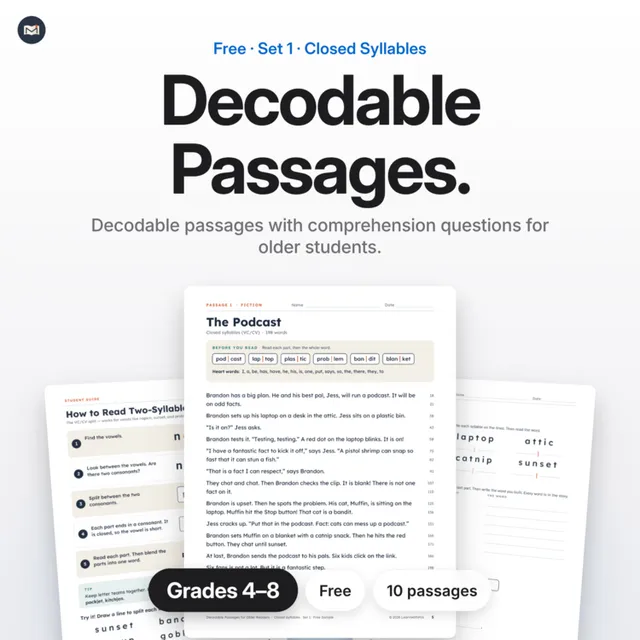
The free Decodable Passages: Closed Syllables set was written for exactly this stage: ten passages for older readers in grades 4 to 8, with questions, word work, phrases and dictation for each, a short heart-word list, and answer keys and running word counts for timed reads.
— Min
Try it with
Free sample · Grades 4–8
Get the free decodable passages
Decodable Passages: Closed Syllables, free for teachers. Join the Learn With Min email list and it comes straight to your inbox, along with new releases.
What's inside
- 10 decodable passages for older readers
- Questions, word work, phrases and dictation for each
- Every word checked for closed syllables (VC/CV), plus a short heart-word list
- Answer keys and running word counts for timed reads
Send me the 51-page sample
Loading the sign-up form…
Occasional emails from Learn With Min. Unsubscribe any time.